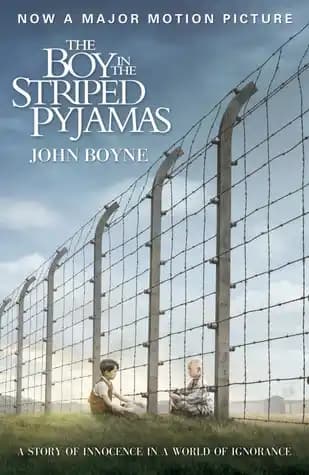
The Boy in the Striped Pyjamas
- Author
- John Boyne
- Published
- January 1, 2006
- Length
- 216 pages
Nine-year-old Bruno knows nothing of the Final Solution and the Holocaust. He is oblivious to the appalling cruelties being inflicted on the people of Europe by his country. All he knows is that he has been moved from a comfortable home in Berlin to a house in a desolate area where there is nothing…
My review
★★★★★ (5/5)
The Boy in the Striped Pyjamas tells the story of Bruno, a nine-year-old German boy growing up during World War II. When Bruno’s father receives a promotion in the army, the family moves from Berlin to Auschwitz. His father is the Commandant of the camp, although Bruno is too young to understand the true nature of his father’s work.
Feeling lonely in this new place, Bruno spends his time exploring the surroundings until one day he reaches a long fence. On the other side, he meets Shmuel, a Jewish boy who shares the same birthday as him. Despite the fence separating them, the two boys begin an unlikely friendship. Through their conversations, Bruno slowly learns small pieces of Shmuel’s reality, that he is separated from his mother and that his father, grandfather, and brother are somewhere inside the camp as well.
Reading their interactions as a reader can be overwhelming. You already know what the place truly is, while Bruno remains innocent and unaware of the horrors happening around him. This contrast between the children’s innocence and the historical reality of the Holocaust is what makes the story so emotionally powerful.
I first read this book in 2020, during the COVID period, when I started picking up reading again after some time away from books. I read it in Portuguese back then, and I still remember how deeply it affected me. It is inevitably a very sad book, and at times it is difficult to read without feeling emotional. For me, it was one of those stories that stays with you long after you finish the last page.
The novel explores themes such as innocence, friendship, and the devastating consequences of prejudice and hatred. Through the eyes of two children, the story highlights how arbitrary the divisions created by adults can be. Bruno and Shmuel see each other simply as two boys who share a birthday and enjoy talking together, even though the world around them insists they are fundamentally different.
At the same time, this book has also received criticism over the years. Some have argued that the story may unintentionally create misconceptions about the Holocaust, particularly because it portrays events that would have been extremely unlikely in reality, such as a child surviving in a camp under those circumstances or a friendship forming across the fence in that way. Because of this, many people emphasize that the book should not be treated as a historically accurate depiction of life in concentration camps.
However, it is important to remember that the novel is a work of historical fiction. Its goal is not to document history but to tell a fictional story that encourages readers to reflect on empathy, innocence, and the human consequences of hatred and discrimination.
Even knowing the criticisms, this was still a book that had a strong emotional impact on me. It is one of those stories that makes you pause and reflect on history, on human behavior, and on how easily innocence can be destroyed by the decisions of adults. While it should not replace historical learning about the Holocaust, it can still serve as a powerful reminder of why remembering that history matters.
For me, it remains a deeply moving and unforgettable read.
Enjoyed this one?
Get new book reviews and articles in your inbox. No spam, unsubscribe anytime.